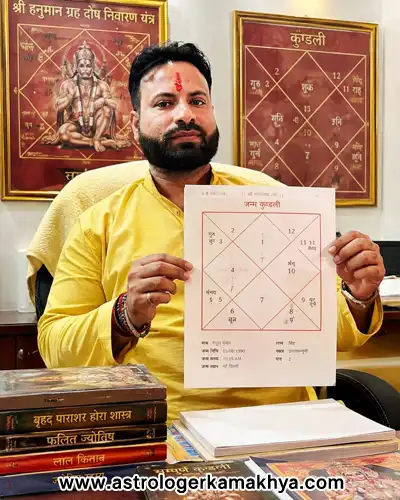
Kamakhya Vedic Astrology - Pandit Ravi Bhargav Ji | Best Hindu Astrologer in India
I have been practicing Vedic astrology - known in Sanskrit as Jyotish Shastra - for over 20 years now, working with clients from across India. Jyotish Shastra is an ancient system rooted in the Vedas that studies the positions of the Navagraha (nine planets) at the time of a person's birth to understand life patterns, karmic tendencies, and timing of key events. At Kamakhya Astrologer, I - Pandit Ravi Bhargav Ji - bring this classical knowledge to people looking for honest, thoughtful astrological guidance. My practice is grounded in the traditional texts of Hindu astrology, and every consultation begins with a careful reading of the Janam Kundali (birth chart).What Vedic Astrology Actually Looks At
Most people come to me thinking astrology is just about knowing the future. But Jyotish Shastra works differently - it reads the Janam Kundali, which maps the position of all nine grahas across 12 bhavas (houses) at the exact moment and place of your birth.Here is what I typically examine during a session:
- Lagna (Ascendant) - the rising sign, which defines personality and how life unfolds
- Rashi (Moon Sign) - emotional tendencies and mental patterns
- Nakshatras - the 27 lunar constellations, each with their own qualities and ruling deity
- Dasha system - planetary periods that indicate when specific themes become active in your life
- Graha positions and their mutual aspects - especially Shani (Saturn), Guru (Jupiter), and Mangal (Mars), whose placement significantly shapes career, relationships, and finances
Common Planetary Doshas I See in Kundalis
Over my 20 years of practice, I have noticed certain recurring patterns in the charts people bring to Kamakhya Astrologer. Understanding these properly is the first step before any remedy is suggested. Shani Sade Sati occurs when Saturn transits through the sign before, the sign of, and the sign after your Chandra Rashi (Moon sign). This roughly seven-and-a-half year period often brings increased responsibilities, delays, and a feeling of things slowing down. It is not inherently negative - Shani teaches discipline and patience - but it does require awareness. Mangal Dosha (also called Kuja Dosha) happens when Mars occupies specific houses - the 1st, 4th, 7th, 8th, or 12th - in the birth chart. In Vedic tradition, this placement has implications for marriage timing and partnership dynamics, which is why Kundali matching before marriage examines this carefully. Kaal Sarp Dosh forms when all seven main planets fall between Rahu and Ketu in the chart. Clients often report feeling stuck or like opportunities keep slipping away during active Kaal Sarp periods. Pitra Dosha relates to ancestral karma and appears through specific configurations of the Sun, Saturn, or Rahu in the 9th house or with the 9th lord. I always explain these to my clients in simple terms - what they mean in the context of their specific chart, not just in general.How I Approach Remedies at Kamakhya Astrologer
Vedic astrology has always included an upay (remedy) tradition alongside its predictive side. The classical texts describe several categories of remedies based on the nature of the planet involved. Mantra recitation is one of the most widely used approaches. Each of the nine planets has associated mantras from the Vedas and Puranas. For example:- For Shani (Saturn): "Om Sham Shanaischaraya Namah" or the Shani Beej Mantra
- For Surya (Sun): "Om Hraam Hreem Hraum Sah Suryaya Namah"
- For Chandra (Moon): "Om Som Somaya Namah"
Areas Where People Seek Guidance
People come to me at different points in life. Some are at a crossroads with career decisions. Others are facing repeated delays in marriage despite trying for years. Some want to understand why a business that seemed promising has not grown the way they expected.Here is what I typically help people understand through chart readings:
- Career and profession - The 10th house (karma bhava) and its lord, along with the 6th house and placement of Surya and Shani, reveal the nature of suitable work and timing of career changes. Dashas of relevant planets often coincide with job changes or promotions.
- Marriage timing and compatibility - Kundali matching (Ashtakoota Milan) compares 8 categories between two charts, giving a compatibility score out of 36 points. Beyond the score, I look at Mangal Dosha status, the 7th house condition, and Venus (Shukra) placement in both charts.
- Financial patterns - The 2nd house (wealth), 11th house (income and gains), and the placement of Dhana yoga combinations in the chart reveal financial tendencies. I also look at Rahu-Ketu axis in relation to these houses.
- Family matters and relationships - The 4th house relates to home and mother. The 3rd and 11th houses indicate sibling dynamics. I read these in the context of active Dashas to help people understand timing and underlying patterns.
Why Clients Across India Choose Kamakhya Astrologer
With over 20 years of practice, I - Pandit Ravi Bhargav Ji at Kamakhya Astrologer - have worked with clients from across India, including people in Delhi, Mumbai, Bangalore, Kolkata, Hyderabad, Chennai, and many smaller cities and towns. What I hear most often from returning clients is that I take time to actually explain the chart rather than just making vague statements. Every person's Kundali is unique - same birth date, different birth time or place means a completely different chart. I treat each reading that way.A few things that define how I work:
- I follow classical Vedic texts - Parashara Hora Shastra, Brihat Jataka, and Phaladeepika - not just generalized modern interpretations
- Remedies I suggest are tied to the specific chart, not generic advice given to everyone
- I do not overstate what astrology can or cannot do - it provides a map, not a predetermined answer
- Consultations are available both in person and online across India
Getting Started With a Consultation
If you are looking for a Vedic astrology reading - whether for a specific concern or just to understand your chart better - I am happy to sit with you and go through it properly. To get the most accurate reading, please keep your exact birth details ready: date of birth, time of birth, and place of birth. The birth time especially matters in Vedic astrology - even a 15-minute difference can shift the Lagna and change several house placements. Contact Kamakhya Astrologer - Pandit Ravi Bhargav Ji today to schedule your consultation.
Astrologer & Tantrik Pandit Ravi Bhargav Ji, Kamakhya, Guwahati, Assam